
Sales : Support :
Registered in England and Wales company # 03449181.
This website does not use cookies.
© Copyright: Conwy Valley Systems Limited 2000 - 2026
Conwy Valley Systems Limited,
West Acre, Llys Helyg, Deganwy
CONWY LL31 9BN, United Kingdom.
VAT# GB 741 5190 48
A Geoscience Wales founding member.
PETROG includes patent protected technology.





News 2026
|
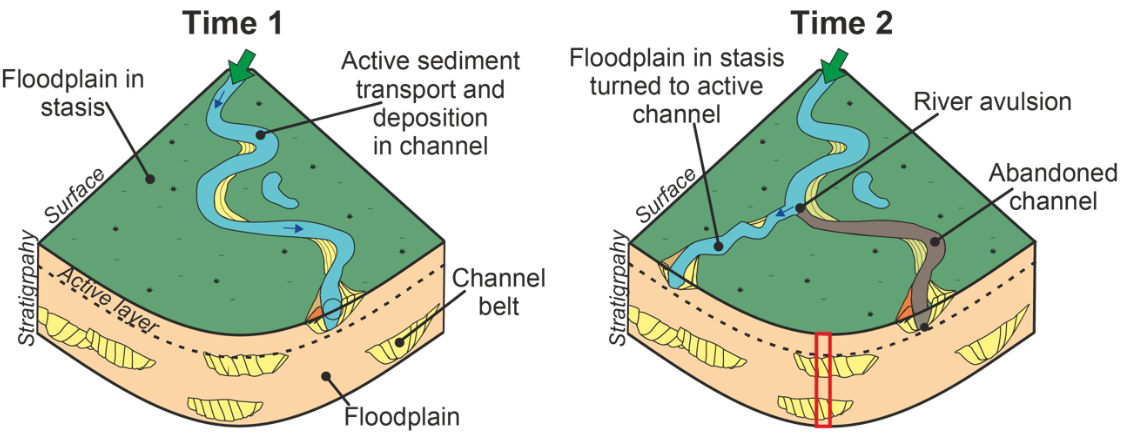
Modelling uncertainty typically involves creating multiple equally likely model scenarios, or realisations, which can be used to model the probability density of outcomes. The development of software that enables construction of realisations from Sequential Gaussian Simulation (SGS) was therefore a significant breakthrough. As Multiple Point Statistics (MPS) was promoted as a further development of geostatistical modelling, potentially replacing SGS, the question is asked: how can this be applied to risk and uncertainty modelling? The answer, that it cannot, is not based on questions of meeting stationarity requirements but on its ability to generate equally likely realisations: as presently implemented in software, it cannot do this and MPS is therefore not useful as a tool for creating models designed to investigate risk. Recent work on flume tank experiments may be able to change this and make MPS models useful for risk analysis. Clearly, it is not feasible to run a flume tank experiment for each experiments realisation but, by using mass balance considerations and parameterising the sediment input to the flume tank experiment, Duller and Straub, at University of Liverpool, UK, and Tulane University, USA, have shown how key reservoir architecture can be parameterised to allow equally likely scenarios to be generated for subsequent input to Monte Carlo models, and hence to generate models of probability density for the required outcomes. Whilst this is limited to a subset of sedimentary processes, it is nevertheless a breakthrough in moving risk and uncertainty analysis forward in line with developments in deterministic modelling. |
|
|
PETROG v6.0.5 now available for download |
| Academic and Research |
| Oil & Gas |
| Coal |
| Concrete |
| Ceramics in Archaeology |
| Cement Clinker |
| Scanned Images, Archives & AI |
| Asbestos |
| Scanned Images |
| Archives and Legacy Data |
| AI & Machine Learning |
| PETROG |
| PetrogLite |
| SteppingStage |
| PETROG Virtual Keyboard |
| PetrogScan |
| PetrogDownhole |
| Cameras |
| Additional Services |
| Features |
| Who Uses Petrog ? |
| Demonstrations |
| FAQ (PETROG) |
| Upgrade from PetrogLite |
| Enquiries |
| Custom Work Flow and Protocols |
| Data Structures |
| Data Capture & Analysis |
| Sample Scanning |
| Reporting |
| Data : Storage & Exchange |
| Area of Interest |
| Set Area of Interest |
| Compositional Analysis Methodology |
| Compositional Data |
| Textural Data |
| Qualifiers and Relationships |
| Microporosity |
| Microporosity and XRD |
| Dictionaried Lists |
| Point counting Application |
| Compositional Data Entry Image |
| Quantitative Composition Summary |
| Photo stitching |
| 'Magic Mouse' for polarised images |
| Report Document |
| Triangular Diagram |
| Compositional Plot |
| Rose Diagram |
| Kite Diagram |
| Concentric Pie Chart |
| Grain Size Analysis |
| Data Storage |
| Data Exchange |
| Touchstone |
| Where is Petrog ? |
| Testimonials |
| Replacing a point counter |
| System Requirements |
| Software |
| Gallery |
| Enquiries |
| 10 years of the SteppingStage |
| Espanol |
| PVK with PetrogLite |
| Cameras and PETROG |
| Supported Cameras |
| HDMI Cameras |
| Discontinued Cameras |
| Training |
| Downloads |
| Change log |
| FAQ (Support) |
| Known issues |
| Future |
| PETROG 6 |
| PetrogLite 6 |
| PETROG Virtual Keyboard (v6) |
| Tutorials |
| YouTube |
| Older versions |
| PETROG 6 Upgrade |
| PETROG 6 Installation |
| PETROG 6 Documentation |
| Evident from Olympus |
| GT Vision (GXCAM) |
| GT Vision (Uvcham) |
| Jenoptik |
| Lumenera |
| Nikon |
| PixeLINK |
| The Imaging Source |
| ToupTek Photonics |
| Zeiss |
| Virtual Image Camera |
| HDMI |
| No Camera |
| PetrogLite 6 Upgrade |
| PetrogLite 6 Installation |
| Documentation |
| PETROG 5 |
| PetrogLite 5 |
| PETROG Virtual Keyboard (v5) |
| PETROG 4 |
| PetrogLite 4 |
| PETROG 3 |
| PetrogLite 3 |
| PETROG 5 Upgrade |
| PETROG 5 Installation |
| Documentation |
| PetrogLite 5 Upgrade |
| PetrogLite 5 Installation |
| Documentation |
| PETROG 4 Upgrade |
| PETROG 4 Installation |
| Documentation |
| PetrogLite 4 Upgrade |
| PetrogLite 4 Installation |
| Documentation |
| PETROG 3 Upgrade |
| PETROG 3 Installation |
| Documentation |
| PetrogLite 3 Upgrade |
| PetrogLite 3 Installation |
| Documentation |
| 6.1.0 |
| 6.0.5 |
| 6.0.4 |
| 6.0.2 |
| 5.8.6 |
| Version 5 (earlier) |
| Version 4 |
| Version 3 |
| Version 2 |
| 5.8.3 |
| 5.8.2 |
| 5.7.0 |
| 5.6.0 |
| 5.5.4 |
| 5.4.0 |
| 5.3.6 |
| 5.3.1 |
| 5.3.0 |
| 5.2.0 |
| 5.1.2.0 |
| 5.1.1.0 |
| 4.8.0.0 |
| 4.7.1.0 |
| 4.6.1.0 |
| 4.5.8 |
| 4.5.6 |
| 4.5.5 |
| 4.5.0 |
| 4.4.2 |
| 4.2.2.0 |
| 4.2 |
| 4.1.0.1 |
| 4.0.2.1 |
| 4.0.0.0 |
| 3.7.1.0 |
| 3.6.1.0 |
| 3.6.0.1 |
| 3.5.3.0 |
| 3.5.1.0 |
| 3.5.0.1 |
| 3.4.0 |
| 3.3.0 |
| 3.2.2.0 |
| 3.2.1.0 |
| 3.1.9.9 |
| 3.1.9.4 |
| 3.1.9.1 |
| 3.1.9.0 |
| 3.1.8.0 |
| 3.1.6.0 |
| 3.10 |
| 3.05 |
| 3.02 |
| 3.01 |
| 2.68 |
| 2.67 |
| 2.66 |
| 2.65 |
| 2.64 |
| 2.45-2.63 |
| Windows 7 Installation |
| PETROG 64-bit |
| "Out of Resources" (2020) |
| Control Box Chip Upgrade (2009) |
| USB - Serial connection |
| News 2026 |
| News 2025 |
| News 2023-24 |
| News 2022 |
| News 2021 |
| News 2020 |
| News 2019 |
| News 2018 |
| News 2017 |
| News 2016 |
| News 2015 |
| News 2014 |
| News 2013 |
| News 2012 |
| News 2011 |
| News 2010 |
| Nikon Small World 2013 |
| Statistical Techniques |
| PETROG in Academia |
| General Articles |
| Quantitative Grain Coat Analysis |
| Point Counting |
| Trask sorting |
| Regional Support |
| Newsletter |
| Newsletter Archive |